Category: Buying a Mobile Home

  • How to Know If a Mobile Home Is Priced Right in San Diego

    How to Know If a Mobile Home Is Priced Right in San Diego

    How to Know If a Mobile Home Is Priced Right in San Diego

    Compare the mobile home with recent sales of similar homes in the same park whenever possible, matching for age, size, condition, layout, upgrades, and included features. Also consider the park itself, including its location, overall quality, amenities, and space rent, because those factors can affect what buyers are willing to pay. Account for needed repairs, then ask a local agent who works with mobile homes to review the comparables before you make an offer.

    Start With San Diego Mobile Home Comparables

    Start with recent sales of similar mobile homes in the same San Diego mobile-home park whenever useful comparables are available.

    Online real estate platforms can help you find listings and sale prices, but compare homes with similar age, size, condition, layout, upgrades, and included features rather than relying on price alone.

    Do not assume a home in a nearby park is automatically a good comparable. Two mobile-home parks only minutes apart can support very different home prices because of differences in location, overall park quality, amenities, buyer demand, and space rent.

    If you need to use sales from another park, compare the parks themselves as well as the homes. For a home in a mobile-home park, also consider how space rent affects the home’s value and your overall monthly housing cost. Once you have a fully accepted offer on a specific home, confirm the current space rent and what it includes directly with park management. You can also use the SD Mobile Home Guide affordability calculator as an educational budgeting tool when comparing the home price with your expected monthly housing costs.

    Compare Recent Sales of Similar Mobile Homes
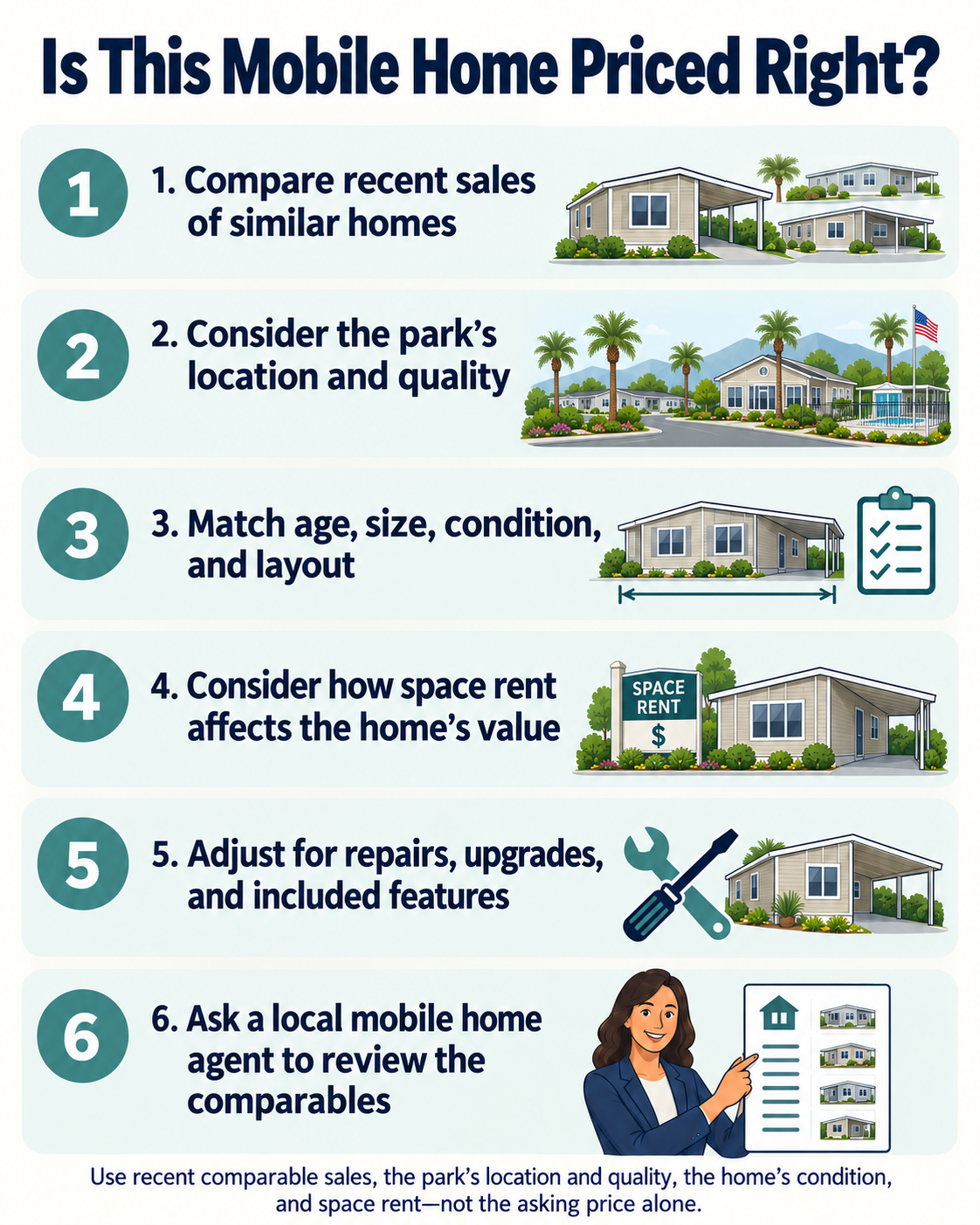
    Mobile home pricing checklist covering recent comparable sales, park location and quality, home condition, space rent, repairs, upgrades, and local mobile home agent review.
    Use recent comparable sales, the park’s location and quality, the home’s condition, and space rent to help judge whether the asking price makes sense.

    Give the most weight to recent sales of similar mobile homes in the same park when judging whether an asking price is reasonable.

    Focus on sales that are recent enough to reflect current conditions, and compare the homes’ age, size, layout, condition, upgrades, and included features.

    If there are not enough useful sales in the same park, you may need to look at other communities. In that case, do not rely on distance alone. Compare the other park’s location, overall condition and appeal, amenities, space rent, and buyer demand.

    Two parks located a short distance from one another can support substantially different home prices if the parks themselves differ.

    Countywide housing statistics can provide broad market context, but they do not establish the value of a particular mobile home.

    Compare Age, Size, and Condition

    Within the most relevant comparable sales, compare mobile homes with similar age, size, layout, and condition.

    Age is one factor in a mobile home’s value, but it should be considered together with condition, size, updates, the park, space rent, and comparable sales.

    Check the square footage and layout, then consider the condition of the roof, plumbing, electrical systems, HVAC, appliances, and other major components.

    Recent improvements and good upkeep may help explain a higher asking price when comparable sales support it, while needed repairs may affect what you’re willing to pay.

    Give greater weight to similar homes in the same park before relying on homes from other communities.

    Consider the Park and Space Rent

    The mobile-home park itself can have a major effect on the value of a home. Consider the park’s location, overall appearance and condition, amenities, buyer demand, and space rent when comparing homes.

    Space rent can also affect what buyers are willing to pay for the home. Two otherwise similar mobile homes may support different sale prices when they are located in parks with different space rents or different levels of buyer demand.

    Use recent sales from the same park whenever possible. If you compare a home with sales from another park, make sure the communities themselves are reasonably comparable rather than assuming nearby parks have similar values.

    Once you have a fully accepted offer on a specific home, get the current space rent, what it includes, utility-billing information, written rules, and other applicable information directly from park management.

    Adjust for Repairs, Upgrades, and Included Features

    Check the mobile home’s systems, repairs, upgrades, and included features before deciding whether its asking price is reasonable. The condition of the plumbing, electrical system, HVAC, roof, and other major components can affect what you may need to spend after buying.

    Ask about their age and condition, inspect the home, and account for needed repairs.

    Upgrades such as newer appliances, updated flooring, improved windows, usable outdoor space, storage, or other desirable features may help explain a difference in price when comparable sales support it.

    Compare those differences with the most relevant recent sales rather than assuming the cost of an upgrade adds the same amount to the home’s value.

    Compare a mobile home’s asking price with recent sales and active listings for similar mobile homes before deciding whether it is reasonable.

    Countywide housing statistics are too broad to establish the value of a specific mobile home, especially when the park, space rent, home condition, and buyer demand can vary substantially from one community to another.

    Give the most weight to recent comparable sales in the same park. When same-park sales are limited, use homes from other parks only after considering differences in the parks’ location, quality, amenities, space rent, and overall desirability.

    Ask a Local Agent Before You Offer

    Ask a local mobile home agent to review recent sales and active listings for the park and home you’re considering. An agent familiar with San Diego mobile-home parks can help identify which sales are actually useful comparables.

    Ask how the home compares with recent sales in the same park and whether differences in age, size, layout, condition, upgrades, or included features help explain the asking price.

    If sales from another park are being used, ask whether that park is truly comparable in location, overall quality, space rent, amenities, and buyer demand rather than relying on geographic proximity alone.

    Conclusion

    To judge whether a mobile home is priced right in San Diego, start with recent sales of similar homes in the same park. Compare age, size, layout, condition, repairs, upgrades, and included features, then consider the park’s location, overall quality, amenities, and space rent.

    Do not assume a nearby mobile-home park is automatically comparable. Two communities only minutes apart can support very different home values. If the asking price is still difficult to judge, ask a local mobile home agent to review the most relevant comparable sales and explain the differences before you make an offer.
  • What to Expect After Your Offer Is Accepted on a Mobile Home in San Diego

    What to Expect After Your Offer Is Accepted on a Mobile Home in San Diego

    What to Expect After Your Offer Is Accepted on a Mobile Home in San Diego

    After your offer is accepted, track the escrow deadlines and complete each step needed to buy the mobile home. Send requested documents to your agent, escrow, and lender promptly. If the home is in a park, go to park management for the current space rent, written rules, utility information, and residency application and approval requirements for that home and space.

    Schedule an inspection with a qualified inspector familiar with manufactured homes. Review the inspection findings and address any repair or price negotiations under your purchase agreement. If your financing requires an appraisal, complete that step and continue working with your lender. As part of the financing process, review and accept the insurance quote required for the loan. Before closing, review the final escrow and lender documents and complete a final walk-through of the home.

    Start With Your Accepted Mobile Home Offer

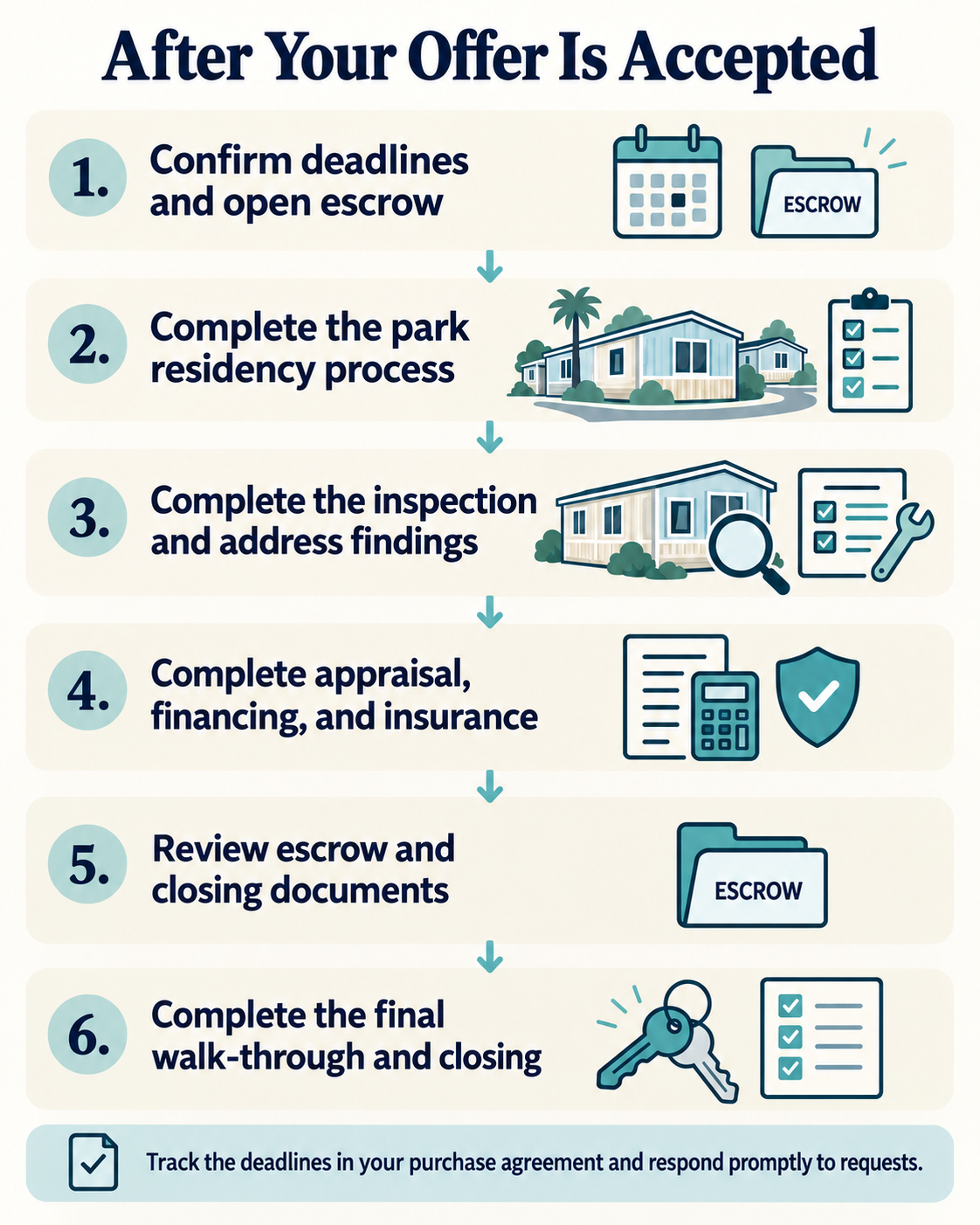
    Post-offer mobile home workflow covering escrow deadlines, park approval, inspection, financing and insurance, closing documents, and final walk-through.
    After acceptance, track escrow deadlines, park approval, inspection findings, financing and insurance, closing documents, and the final walk-through.

    After the seller accepts your offer, begin the park approval process and confirm your financing, inspection, and closing requirements.

    Park applications may request financial information, identification, a background check, age-related information for an age-restricted community, or other information used in the park’s screening process. Ask the park manager for the specific requirements that apply to the community.

    Arrange an inspection of the mobile home with an inspector familiar with manufactured-home construction. The inspector can check the structure, support system, plumbing, electrical system, and other accessible components.

    Review your purchase agreement’s contingencies and deadlines so you understand what must happen for the sale to proceed and what options the agreement gives you if an issue arises.

    Gather the income, asset, credit, and other documents your lender requests, and continue the financing process.

    Before closing, review the expected loan, escrow, insurance, and other transaction costs that apply. For a park home, also confirm the current space rent, separately billed utilities, and other recurring park charges with park management. You can use the SD Mobile Home Guide affordability calculator as an educational budgeting tool to see how those housing costs may fit your budget.

    Confirm Deadlines and Open Escrow

    Check your purchase agreement for deadlines to open escrow and complete inspections, appraisals, financing, park approval, and other contingencies that apply to your transaction.

    These dates determine when you must act and can affect whether the sale proceeds under the agreed terms.

    Escrow holds funds and documents while the transaction’s conditions are completed.

    Confirm the deadlines with your agent and escrow officer, and ask them to explain anything unclear.

    Send requested documents, such as proof of funds and required disclosures, promptly, and contact the appropriate transaction professional if an issue could affect a deadline.

    Get Park Residency Approval in Writing

    If the home is in a mobile-home park, complete the park’s residency application and approval process before completing the purchase. Follow your purchase agreement for the timing of any park-approval contingency or other contingency decisions.

    Park management may request information about your financial ability to pay the park rent and charges, identification, a background check, prior tenancy information, age-related information for an age-restricted community, or other information permitted as part of its screening process. Ask management for the current written requirements rather than relying on a general income multiple or another park’s standards.

    Request written confirmation of the park’s decision and keep it with your transaction records.

    If anything about the approval is unclear, ask the park manager and your agent or transaction professional before you proceed.

    Schedule a Mobile Home Inspection and Address the Findings

    Schedule an inspection after the seller accepts your offer and within the inspection period in your purchase agreement. A qualified inspector can assess the mobile home’s condition before closing and identify issues that may need further evaluation or repair.

    Choose an inspector familiar with manufactured-home construction and ask them to examine the support system, marriage line when applicable, plumbing, electrical system, roof, and other accessible components.

    When you receive the report, review the findings with the inspector and ask which concerns are urgent, which may need a specialist, and which can be planned for later.

    If the report identifies needed repairs, use the documented findings to discuss repairs, a price adjustment, or other terms with the seller, subject to your purchase agreement. Put any agreed changes in writing.

    Any repairs the seller agrees to complete can be checked again during the final walk-through before closing.

    Review the Mobile Home Appraisal

    If your lender requires an appraisal, the appraisal estimates the home’s value for the financing decision. The appraiser may consider comparable manufactured-home sales, the home’s age and condition, and other characteristics relevant to the appraisal.

    Review the appraisal report for the estimated value and any conditions or concerns noted for the loan. If the appraised value is below the purchase price, ask your lender and agent about the options available under your financing and purchase agreement.

    Keep the appraisal separate from the home inspection: an appraisal is primarily a valuation for the lender, while the inspection is intended to evaluate the home’s condition in more detail.

    Complete Financing and Insurance

    After your offer is accepted, continue the financing process for the type of manufactured home and site arrangement you are buying.

    For an existing home in a mobile-home park, ask the lender whether it finances used manufactured homes on rented or leased spaces and what home, park, or site documents it needs. Home-only or personal-property financing may be available for some park homes.

    If the manufactured home is sold with owned land, mortgage financing may be available when the property and borrower meet the lender’s and loan program’s requirements. Some government-backed manufactured-home programs can also apply to homes on leased lots, so do not assume land ownership by itself determines the available loan type.

    Provide the income, asset, credit, and property information the lender requests. Park residency approval is a separate process from lender underwriting, although the lender may request park or site documents for the loan.

    As part of the financing process, you will receive an insurance quote to review and accept. The required insurance coverage needs to be in place for the lender to complete the financing, so respond promptly to any insurance documents or requests connected with the loan.

    Review Escrow and Closing Documents

    As the transaction moves toward closing, escrow coordinates the ownership-transfer paperwork, including the title and registration transfer, and lets you know which documents or signatures are required from you.

    You do not need to independently clear the title or manage the seller’s title and registration. Respond to requests from escrow and ask the escrow officer or your agent about anything you do not understand.

    Review the final lender and escrow documents, including the charges and terms that apply to your transaction, before signing.

    Complete the Walk-Through and Close

    Before closing, walk through the mobile home and confirm it is in the agreed condition. If the seller agreed to complete repairs after the inspection, check that those items have been addressed.

    Check the status of the purchase agreement’s contingencies, including park approval, inspection, and financing when applicable.

    Review the final lender and escrow documents and ask about any charge or term you do not understand before signing. If your loan uses a Closing Disclosure, review that document as part of the process.

    Make sure the required insurance coverage is in place and that you know the amount and method required for any funds due at closing.

    Sign the documents required to complete the purchase. Escrow handles the title and registration transfer as part of the closing process. Possession and delivery of the keys should follow the timing stated in your purchase agreement and closing instructions.

    Conclusion

    After your offer is accepted, track each deadline and respond promptly to requests. Get the current park information and complete the residency-approval process, arrange the mobile home inspection, address any inspection-related negotiations, and complete the appraisal, financing, and required insurance steps.

    Escrow handles the title and registration transfer as part of closing. Review the final lender and escrow documents, complete the walk-through, confirm any agreed repairs have been addressed, and follow the closing and possession instructions for the transaction.

  • Should You Buy a Mobile Home in a Park or With Land in San Diego?

    Should You Buy a Mobile Home in a Park or With Land in San Diego?

    Should You Buy a Mobile Home in a Park or With Land in San Diego?

    Buying a mobile home with land gives you ownership of both the home and the property, while a park home usually means buying an existing home in the community and paying rent for the space beneath it. That difference affects your ongoing costs, control over the property, and financing options.

    If you are buying an existing manufactured home with owned land, review the property and title status, utilities, and ongoing costs. If you are buying private land to place a manufactured home, also check zoning, delivery access, installation requirements, permits, and utility hookups. For a park home, compare the expected space rent and park costs when deciding which option fits your budget; once you have a fully accepted offer on a specific home, get the current rent, written rules, and residency-approval information directly from park management.

    Should You Buy a Mobile Home in a Park or on Land?

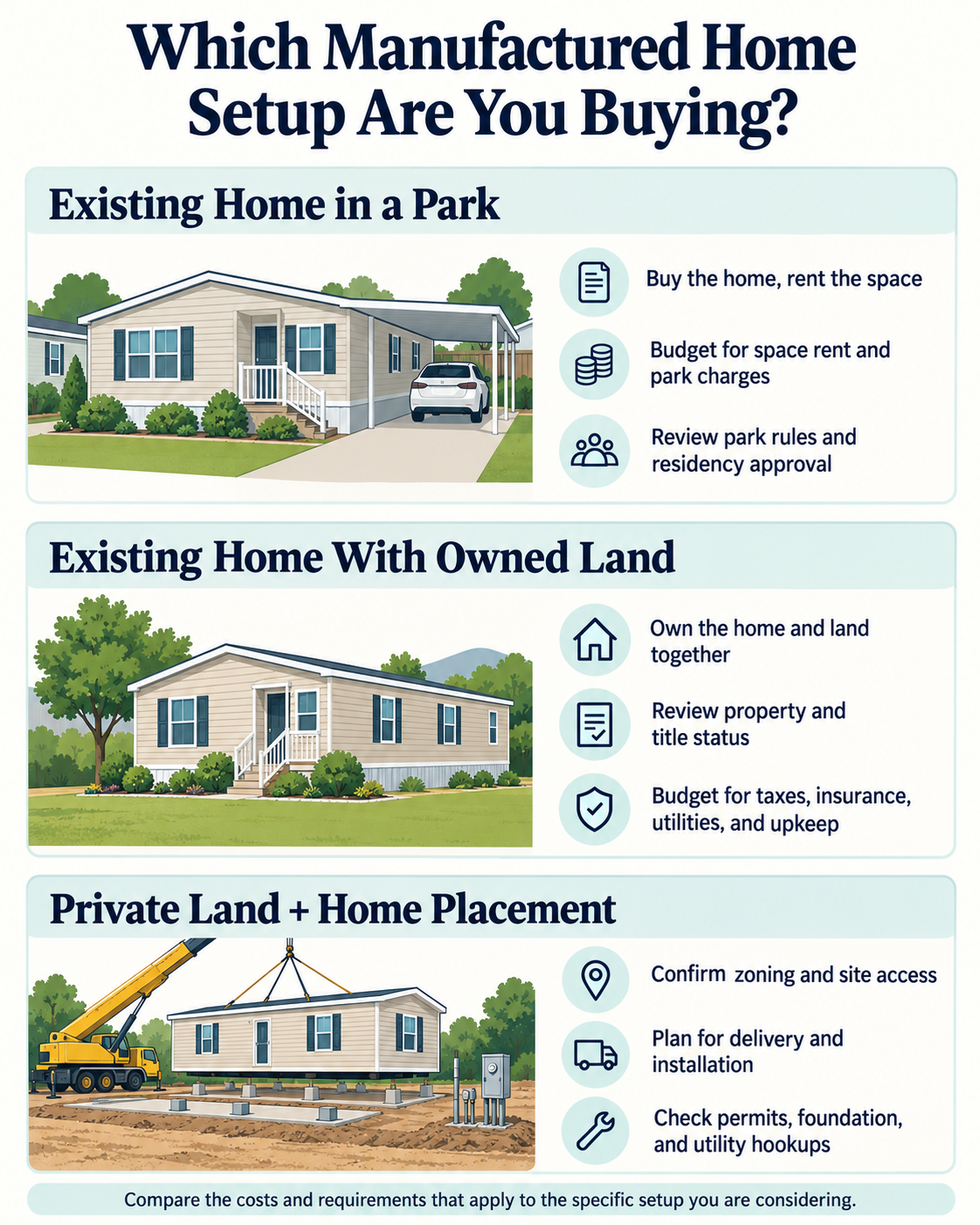
    Comparison of an existing mobile home in a park, an existing manufactured home with owned land, and a manufactured home placed on private land.
    Separate an existing park-home purchase from an existing home with owned land and a private-land placement project before comparing costs and requirements.

    Whether you buy a mobile home in a park or with land depends on how much control you want and how the home and land are owned. In a park, you buy an existing home and rent the space it occupies. You may also have access to shared amenities and a community setting.

    Buying a manufactured home with owned land may give you more control over the property, subject to local rules and any other restrictions that apply.

    Financing may also differ. Some park homes are financed with home-only or personal-property loans, while some manufactured homes sold with owned land can use mortgage financing when the property and borrower meet the lender’s and loan program’s requirements.

    Before choosing, confirm the land or space arrangement and ask lenders which financing options they offer for that type of manufactured home.

    What Does a Mobile Home in a Park Cost?

    Purchase prices and space rents vary widely across San Diego mobile-home parks based on the specific home, community, location, and current park charges.

    For a park purchase, budget for the home price, space rent, separately billed utilities, insurance, maintenance, repairs, financing or closing costs, and any other recurring park charges that apply.

    Once you have a fully accepted offer on a specific home, ask the park manager for the current space rent, what it includes, and any other recurring charges. Use the SD Mobile Home Guide affordability calculator as an educational budgeting tool to compare those housing costs with your budget.

    Financing options can also depend on the home’s title or property status and the lender or loan program.

    What Does Land Need for a Mobile Home?

    If you are buying private land to place a manufactured home, confirm that local zoning allows the planned use and that the parcel can support the installation.

    Check access to water, electricity, and sewer or other approved wastewater service, and find out what utility connections the project requires.

    Ask the local building department what site, grading, soils, foundation, installation, and inspection requirements apply to that parcel.

    Foundation and installation requirements depend on the home, site, jurisdiction, and financing program. If the home will be permanently installed on owned land and treated as real property, recorded foundation documentation, including an HCD Form 433A when applicable, may be part of that process.

    These site-preparation and installation steps apply to a private-land project, not the normal purchase of an existing home already located in a San Diego mobile-home park.

    How Do Lot Rent and Ownership Affect Value?

    In a land-lease community, you own the mobile home but rent the space. That monthly payment affects your ongoing housing cost and is one factor buyers may consider when comparing a park home with a home sold with owned land.

    Once you have a fully accepted offer on a specific park home, get the current space rent, charges, and written rent terms directly from park management.

    The home and the underlying land are separate interests in a typical space-rent community, so buying the home does not mean you own the park space.

    Resident-owned, condominium, cooperative, or other ownership structures can work differently. Review the actual ownership and fee documents for the property rather than assuming every community uses the same arrangement.

    How Can You Finance a Park or Land Home?

    Manufactured-home financing depends on the home, the land or site arrangement, title and property status, the lender or loan program, and the borrower’s finances.

    For an existing home in a mobile-home park, ask lenders whether they finance used manufactured homes on rented or leased spaces and what home, park, or site requirements they have.

    For a manufactured home sold with owned land, ask about mortgage programs for manufactured housing and the property, foundation, appraisal, and title requirements that apply.

    Do not assume that owning the land automatically makes a particular FHA, VA, USDA, conventional, or other loan program available. Ask the lender to identify the programs it offers for the specific home and property.

    What Permits Does San Diego County Require?

    If you are placing a manufactured home on private land, the required permits and reviews depend on the parcel and the local jurisdiction.

    For property in unincorporated San Diego County, County Planning & Development Services is the local agency to ask about the project. Property inside an incorporated city may be handled by that city’s building or planning department.

    Ask the applicable agency which building, foundation, grading, utility, installation, and inspection requirements apply before committing to a private-land placement project.

    This permit discussion applies to installing a manufactured home on private land, not to the normal purchase of an existing home already located in a mobile-home park.

    Can the Parcel Support Utilities and Home Delivery?

    Before buying a parcel for a manufactured-home placement project, confirm that it can support the home and provide access for delivery and installation.

    Check whether water, electricity, and sewage connections are available, and ask the relevant utility providers or local agencies what installation requires. If public connections are not feasible, confirm what private systems are allowed and suitable for the site.

    Review zoning, site conditions, and access requirements with the appropriate local agencies and professionals.

    Also check that the site’s dimensions and layout leave enough room for delivery vehicles and installation equipment to reach the placement area.

    Which Option Fits Your Budget and Lifestyle?

    Neither a park home nor a home with owned land is automatically the less expensive choice. Compare the actual purchase price and the ongoing costs for the specific property.

    A park purchase adds space rent and any recurring park charges. A home with owned land has a different cost structure, while a private-land placement project can also involve delivery, site preparation, permits, foundation work, and utility connections.

    Financing can differ too, so compare the actual loan terms available for the home and land arrangement you are considering.

    Also consider how much you value community amenities and shared rules compared with greater control over owned land.

    Conclusion

    For a San Diego park purchase, you are typically buying an existing home already located in the community and separately budgeting for space rent and other recurring costs. Once you have a fully accepted offer, get the current rent, written rules, utility information, and residency-approval requirements from the park manager before completing the purchase.

    If you are buying a manufactured home with owned land, review the home and property together. If you are buying private land to place a manufactured home, also account for zoning, delivery, site preparation, permits, utilities, and installation. Compare the full costs, financing options, and level of control each arrangement offers before deciding.

  • How to Evaluate an Older Mobile Home Before Buying in San Diego

    How to Evaluate an Older Mobile Home Before Buying in San Diego

    How to Evaluate an Older Mobile Home Before Buying in San Diego

    Before buying an older mobile home in San Diego, confirm the home’s identity, inspect its condition, and understand the costs and rules that apply to its space. Check the year built and available identifying information, and ask about additions or exterior changes that may have required approval. For a manufactured home, make sure the available records correspond to the home.

    Inspect the roof, support system, crawl space, floors, windows, plumbing, wiring, and heating system. Look for leaks, structural movement, and safety problems. In an older home, ask the inspector whether testing for mold, lead-based paint, asbestos-containing materials, or other hazards is appropriate based on the home’s age, materials, and condition.

    If the home is in a park, get the current space rent, utility arrangements, written rules, and residency requirements directly from park management. In many transactions, the buyer receives this park-specific information after there is a fully accepted offer. A qualified inspector can identify problems you might miss and provide findings to discuss with the seller before you complete the purchase.

    Confirm the Older Mobile Home’s Age and Code Status

    Check the home’s year and identifying information using the records that apply to the home. Homes built before the federal manufactured-home construction standards took effect in 1976 were built under earlier standards.

    Age can affect condition, repair needs, available parts, and the type of inspection or follow-up evaluation that may be appropriate.

    If the home has additions, exterior changes, or other noticeable alterations, ask what work was done and whether any required park or agency approvals applied. Avoid assuming that every alteration follows the same approval or permit process.

    Have a qualified inspector examine the home’s support system and visible structural components and document any concerns.

    Spot Structural Damage and Water Intrusion

    Inspect a mobile home for structural damage and water intrusion, since both can lead to significant repair needs.

    Look for cracks, uneven floors, or shifted sections that may signal movement or settling. Check the crawl space for water stains, damp areas, or mold, which can point to leaks or drainage problems.

    Examine window seals and weatherstripping for gaps or deterioration that could let in moisture. Look for rust on metal components and check the roof for damaged materials, sagging, or other signs of wear.

    If you find signs of damage or leaks, have a qualified inspector assess the cause and needed repairs.

    Inspect the Roof, Support System, and Crawl Space

    Inspect the roof, support system, and crawl space for damage that could affect the home’s stability, comfort, or weather protection.

    On the roof, look for damaged or deteriorated materials that could let water in. Ask the inspector to check the piers, supports, and visible structural connections for movement, deterioration, or other concerns.

    In the crawl space, check for moisture, mold, pest activity, damaged materials, and signs of plumbing leaks.

    Poor ventilation or ongoing moisture can contribute to deterioration, while pests can damage building materials.

    Also note the condition of insulation and weatherproofing where visible.

    Check Plumbing, Wiring, and Heating Systems

    Check the plumbing, wiring, and heating systems for wear, damage, and safety concerns.

    Ask a qualified inspector to check for leaks, corrosion, drainage problems, and other visible plumbing issues. If the inspector identifies a concern that requires further evaluation, follow up with the appropriate specialist.

    Have electrical concerns evaluated by a qualified electrician when needed, especially if the inspector finds damaged wiring, questionable connections, or an older electrical panel.

    Test the heating system, and ask about its age, condition, and operation.

    Review any available maintenance information and plan for repairs or replacement if equipment is worn or unreliable.

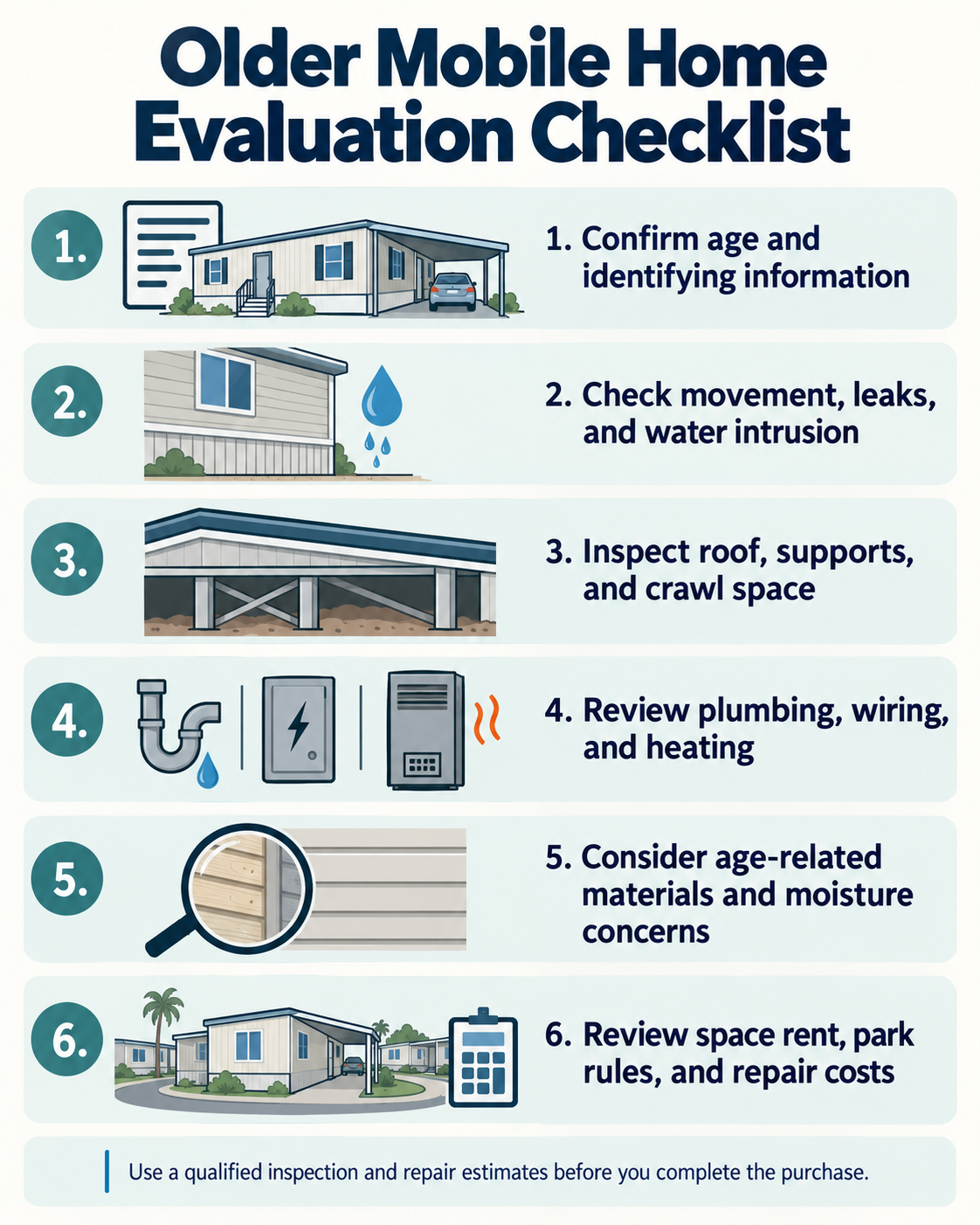
    Older mobile home evaluation checklist covering identity, structure, moisture, major systems, age-related materials, and park costs.
    Evaluate the home’s condition, major systems, age-related concerns, park requirements, and likely repair costs before completing the purchase.

    In an older mobile home, look for moisture problems and ask the inspector whether the home’s age, materials, or condition suggest that specialized testing is appropriate.

    Homes built before 1978 may warrant additional attention to lead-based paint, while some older building materials may contain asbestos. These possibilities do not mean every older home has a hazard that requires testing.

    Check damp areas for discoloration, staining, soft materials, or musty odors that may indicate an ongoing moisture problem.

    Do not disturb suspect materials simply to determine what they contain. If testing or further evaluation is appropriate, use a qualified professional.

    Ask the seller about any inspection or remediation records they have, but do not assume complete records will exist for every older home.

    Review Park Rules, Space Rent, and Ownership Costs

    If the home is in a park, get the current written rules, space rent, utility information, and residency requirements directly from the park manager. In many transactions, this park-specific information is provided after you have a fully accepted offer.

    Review the rules that apply to residents, including any pet, age, guest, or exterior-change requirements that are relevant to your household and plans.

    Confirm the current space rent, recurring park charges, and what the rent includes.

    Then estimate your monthly costs for utilities, insurance, maintenance, and anticipated repairs. If inspection findings change your expected repair budget, use the SD Mobile Home Guide affordability calculator as an educational budgeting tool to see how the overall costs may fit your budget.

    Hire an Inspector and Use Findings Before Closing

    Arrange a qualified inspection during the transaction and before completing the purchase. Ask the inspector to examine the support system, roof, plumbing, electrical system, and other accessible components and to document signs of water damage, pests, or structural movement.

    Read the report and ask which repairs are urgent and what maintenance may be needed later.

    Use documented findings to discuss repairs, a price adjustment, or other terms with the seller, subject to your purchase agreement.

    The report can also help you estimate repair costs and decide whether the home still fits your budget.

    Conclusion

    Before buying an older mobile home in San Diego, inspect its condition, ask about additions or exterior changes, and review the current park information that applies to the home and space. Have a qualified inspector look for water damage, structural movement, electrical or plumbing concerns, and materials that may need specialized evaluation.

    Use the inspection findings and repair estimates to understand the home’s condition and discuss any repair or price issues with the seller under your purchase agreement before completing the purchase.

  • What to Look for During a Mobile Home Inspection in San Diego

    What to Look for During a Mobile Home Inspection in San Diego

    What to Look for During a Mobile Home Inspection in San Diego

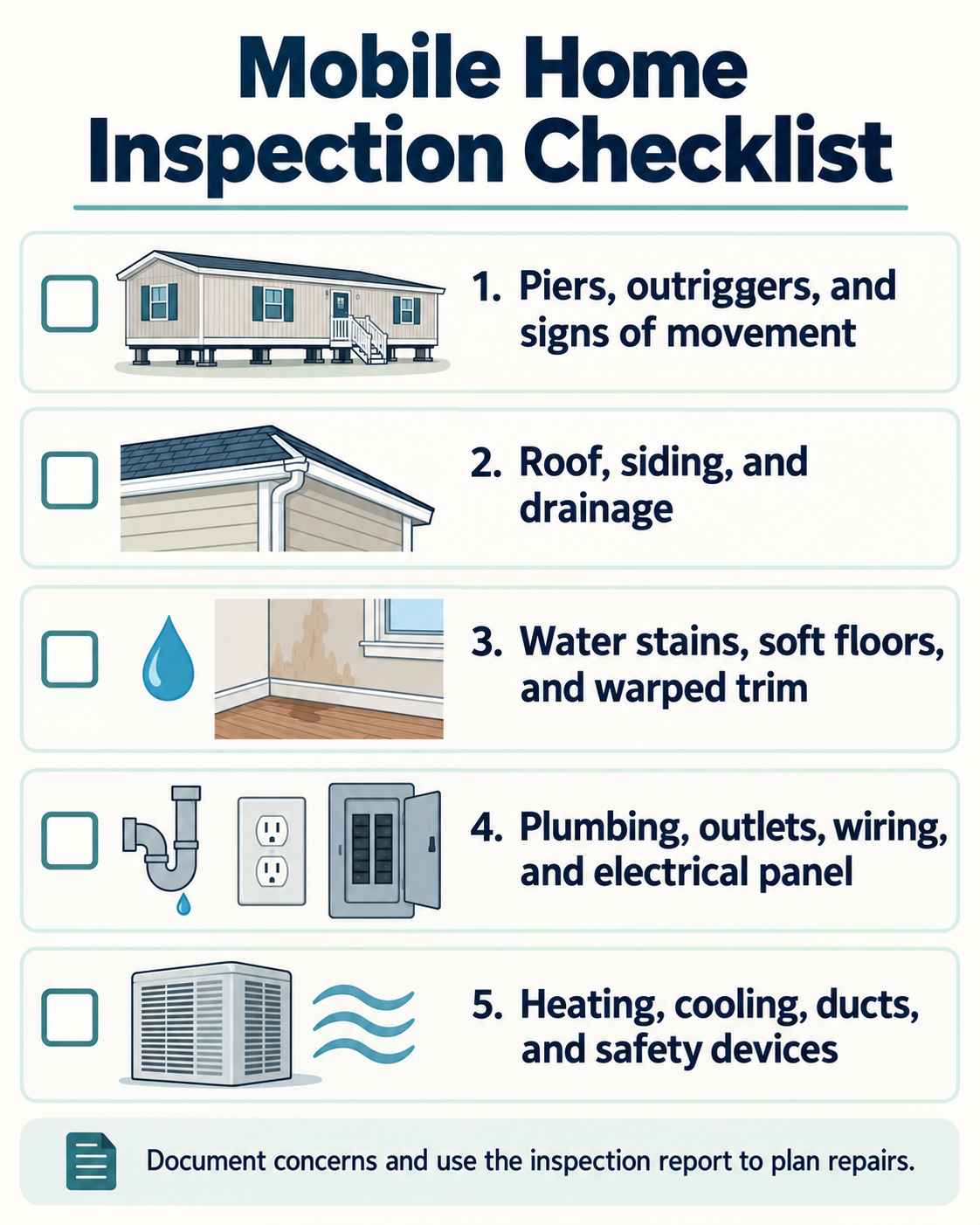
    A mobile home inspection can uncover structural, water, electrical, and mechanical problems before they become harder to address. Ask the inspector to check the piers and outriggers for loose connections, misalignment, or signs of settling, then examine the roof and siding for damage, pests, and water entry.

    Inside, look for water stains, soft flooring, and warped trim. Test plumbing fixtures, and have the inspector check outlets, wiring, and the electrical panel. They should also assess the heating and cooling systems, ducts, and safety devices. Use the inspection report to identify needed repairs and decide which issues require attention first.

    Check Mobile Home Supports for Movement

    Check the outriggers and foundation piers for loose connections, poor alignment, or signs of settling.

    Movement can cause cracks in walls, uneven floors, or gaps along marriage lines, where sections of the home join.

    Make sure the supports follow the manufacturer’s specifications and applicable local codes.

    Ask your home inspector to check the piers and outriggers and document any concerns.

    Address visible movement or loose connections promptly to help prevent further structural damage.

    Inspect the Mobile Home Roof and Siding

    Inspect the roof and siding for damage that could let water into your mobile home. Look for missing shingles, weather damage, pest activity, cracked or warped siding, and peeling paint.

    These signs may point to leaks or moisture problems that need repair.

    Check the roof’s age and condition to see whether it may need replacement.

    Also make sure water drains away from the siding and foundation rather than pooling beside them.

    Addressing damage and drainage problems early can help prevent leaks and further deterioration.

    Spot Water Damage on Walls and Floors

    Look for stains, discoloration, or peeling paint on walls and floors. These can signal a leak or moisture trapped behind the surface.

    Soft or spongy flooring near sinks, toilets, or other plumbing may indicate water has reached the subfloor.

    Check baseboards and trim for swelling or warping, and look at ceilings for stains or sagging, especially below bathrooms and kitchens.

    These signs may point to hidden water damage in a mobile or manufactured home.

    Ask a qualified home inspector to assess any areas of concern and identify the source.

    Test Mobile Home Plumbing and Electrical

    Test faucets, toilets, and other plumbing fixtures for leaks, clogs, and corrosion.

    Check walls and ceilings for water stains, which can indicate hidden leaks. Run taps throughout the mobile home and note any drop in water pressure; blockages or leaks may be the cause.

    In an older home, ask the inspector to assess the plumbing’s condition and note signs that further evaluation or replacement may be needed.

    Test every outlet and switch, and look for exposed or damaged wiring.

    Check the electrical panel for wear and outdated components.

    Have a qualified electrician assess any safety concerns or repairs the inspector identifies.

    Check Heating, Cooling, and Airflow

    Have a qualified home inspector test the heating and cooling equipment, check its age and condition, and confirm it operates safely.

    Older equipment may need repair or replacement, so ask the inspector to note any concerns.

    Check the ducts for leaks or blockages that can reduce airflow and waste energy.

    Replace dirty filters as needed, and test carbon monoxide detectors to confirm they work and are installed in appropriate locations.

    These checks help keep your mobile home comfortable and support safe, efficient operation.

    Use the Inspection Report to Plan Repairs

    Mobile home inspection checklist covering supports, roof and siding, water damage, plumbing and electrical, and heating and cooling.
    Check the home’s supports, exterior, moisture signs, plumbing, electrical, and heating and cooling systems, then document concerns in the inspection report.

    Use the inspection report to prioritize repairs, starting with safety hazards and urgent concerns such as active leaks, electrical problems, or structural movement.

    Share the findings and photos with contractors so they can identify the work your mobile home needs. Use their estimates to set a repair budget and decide which upgrades can wait.

    If you’re buying a home, use documented defects to discuss repairs, a price adjustment, or other terms with the seller, subject to your purchase agreement.

    If the inspection findings change the repair budget you expect to carry after the purchase, use the SD Mobile Home Guide affordability calculator to see how those costs may fit your overall budget.

    Keep the inspection report for future reference so you can track maintenance and recurring problems over time.

    After repairs, schedule any recommended follow-up inspections to check that the work was completed properly.

    Conclusion

    Inspect the mobile home’s structure and major systems for movement, damage, leaks, and signs of malfunction. Check the supports, roof, siding, walls, and floors, then test the plumbing, electrical, heating, cooling, and ventilation systems.

    Ask the inspector to explain each concern and include it in the report. Use the findings to identify needed repairs, get cost estimates, and discuss them with the seller before completing the purchase.

  • Mobile Home Buying Checklist for San Diego Buyers

    Mobile Home Buying Checklist for San Diego Buyers

    Mobile Home Buying Checklist for San Diego Buyers

    Before buying a mobile home in San Diego, budget for the purchase, down payment, lot rent, utilities, inspections, repairs, and closing costs. Decide whether you want to live in a park or buy private land, then check the zoning, financing options, and ongoing fees that apply.

    If you choose a park, understand that the buyer typically gets the current rent, rules, and approval information directly from the park manager after a fully accepted offer. Confirm that the seller or mobile home sales agent has the title and registration ready for the transfer, and verify the home’s age and condition. Get pre-approved by a lender and ask escrow to confirm any transfer fees. The checklist below covers each step.

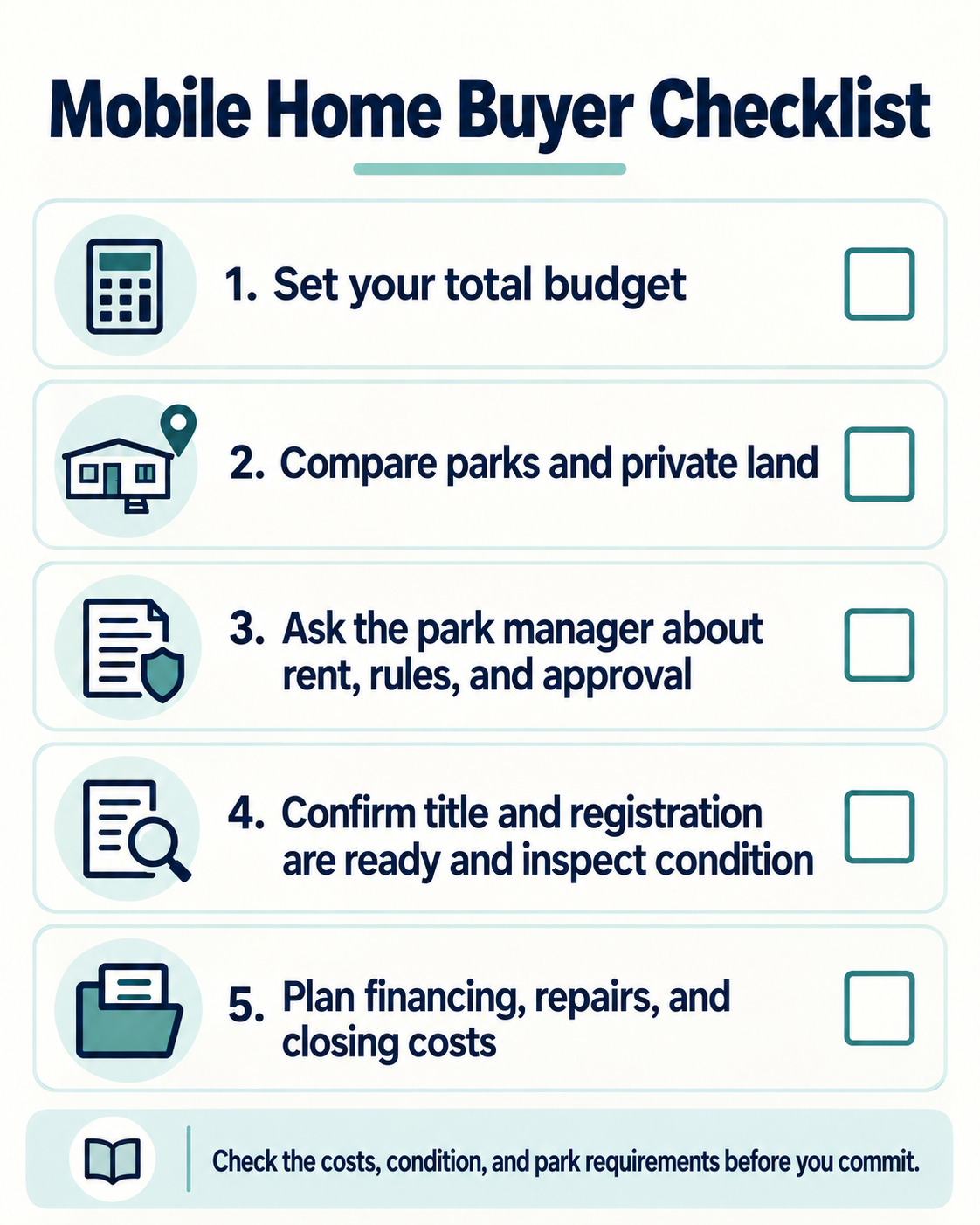
    Mobile home buyer checklist covering budgeting, comparing parks and private land, asking the park manager about rent and approval, confirming title and registration are ready, inspecting condition, and planning financing, repairs, and closing costs.
    Use these steps to compare costs, condition, park requirements, and transaction details when buying a mobile home in San Diego.

    Set Your Budget for Buying a Mobile Home

    Set a budget that includes the mobile home and the costs of owning it. Add the purchase price, space rent, utilities, maintenance, and closing costs for escrow and title transfer.

    Ask the seller or escrow company which fees apply to your purchase.

    Plan for a down payment and keep proof of funds ready if you’re applying for financing. Include the home’s applicable property taxes or HCD registration and in-lieu license fees in your ongoing costs.

    Use a mobile home loan calculator to estimate payments, then check that the full monthly cost fits your budget. You can also use the SD Mobile Home Guide affordability calculator to estimate what may fit your budget before you shop.

    Compare San Diego Parks and Private Land

    Compare the total costs and restrictions of buying a mobile home in a park with placing a manufactured home on private land.

    A park may cost less upfront and include shared amenities, but you’ll pay lot rent, which may increase.

    On private land, you avoid lot rent and have more control over changes to the home and property.

    Before choosing, check zoning and building requirements for private land and compare them with the ongoing costs and lifestyle considerations of park living.

    Ask lenders which financing options apply to each setup, since requirements may differ.

    Resale value can also depend on the park or the property’s broader real estate market.

    Check Park Rules, Rent, and Approval

    If the home is in a park, the buyer typically gets the current lease, rules, space rent, and approval information directly from the park manager.

    In many transactions, you will need a fully accepted offer before the park provides the specific rent, rules, and buyer-approval details that apply to that home and space.

    Ask the manager about the park’s approval process, current space rent, community rules, and any other fees that may apply.

    In California, the Mobilehome Residency Law sets out tenant rights and park obligations in manufactured housing communities.

    Review the written terms alongside your budget so you understand the costs and rules that will apply if you move forward.

    Inspect the Home’s Title, Age, and Condition

    Check the mobile home’s age and condition before you buy, and confirm that the seller or mobile home sales agent has the title and registration ready for the transfer. These records can help confirm ownership and support the transfer process.

    In a typical sale, the seller or mobile home sales agent holds the title and registration documents until they are turned over for the transaction. Also confirm the home’s tax status: manufactured homes first sold new on or after July 1, 1980, are generally subject to local property tax, while some homes first sold new before that date remain on HCD’s in-lieu license-fee system unless their tax status has changed.

    Verify the applicable requirements with the relevant agency.

    Hire a qualified inspector to check the roof, plumbing, and electrical systems. If the home has additions, exterior changes, or other noticeable alterations, ask questions about the work and whether any approvals were needed.

    Plan Financing, Repairs, and Closing Costs

    Set a budget that includes the purchase price, repairs, closing costs, and ongoing expenses.

    Before making an offer, ask a lender experienced in mobile-home financing for pre-approval. This can clarify your borrowing options and help you prepare the required financial documents.

    Plan for the down payment and set aside funds for repairs found during the inspection, such as roof damage or plumbing leaks.

    Ask the lender and closing professionals for an estimate of fees, including escrow and title transfer costs, and ask the park manager whether any application-related charges apply.

    If the home is in a San Diego park, include monthly lot rent and other park fees in your budget.

    Conclusion

    Before buying a mobile home in San Diego, set a budget that includes the purchase, financing, repairs, and closing costs. Compare homes on private land with those in parks, where rent, rules, and approval requirements may affect your plans.

    Check the home’s age and condition, confirm that the seller or mobile home sales agent has the title and registration ready for transfer, and get current park information directly from the manager when applicable. These checks can reveal costs or restrictions before you commit.