Category: Financing, Costs & Ownership

  • Can You Finance a Manufactured Home in a San Diego Mobile Home Park?

    Can You Finance a Manufactured Home in a San Diego Mobile Home Park?

    Can You Finance a Manufactured Home in a San Diego Mobile Home Park?

    Yes, you may be able to finance an existing manufactured home in a San Diego mobile home park even if you don’t own the land. A lender may offer a chattel loan, which uses the home as collateral rather than the land. Financing options and requirements vary by lender, home, transaction, and park.

    When working with a mobile home sales agent, the agent can coordinate much of the financing-related process, including home information, connections with lenders that finance used park homes, purchase documents, and communication with the seller, escrow, and park management. The buyer generally reviews and accepts an offered lender and loan option, provides personal financial information, completes the park’s personal residency application or screening requirements, and signs lender documents. SD Mobile Home Guide is not a lender or underwriter. For help exploring homes for sale, visit SD Mobile Home Guide.

    Can You Finance a Home in a San Diego Park?

    You may be able to finance a manufactured home in a San Diego park, but financing can differ from a home sold with land. In a typical park transaction, you are buying an existing home already located in the community while leasing the space beneath it.

    A mobile home sales agent can help provide the home’s identifying information and condition details and connect buyers with lenders that finance used manufactured homes in parks. Financing is often arranged through 21st Mortgage in the agent-assisted workflow described here, although other lenders and options may be available depending on the transaction.

    The lender determines its financing requirements and reviews the buyer’s personal financial information. The buyer reviews the offered financing arrangement and decides whether to accept the lender and loan terms.

    After you have a fully accepted offer, the agent can help coordinate the current space rent, written rules, rental or lease information, and residency requirements with park management. The buyer completes any personal application, screening information, or signatures requested by the park.

    Which Loans Fit Manufactured Homes on Rented Lots?
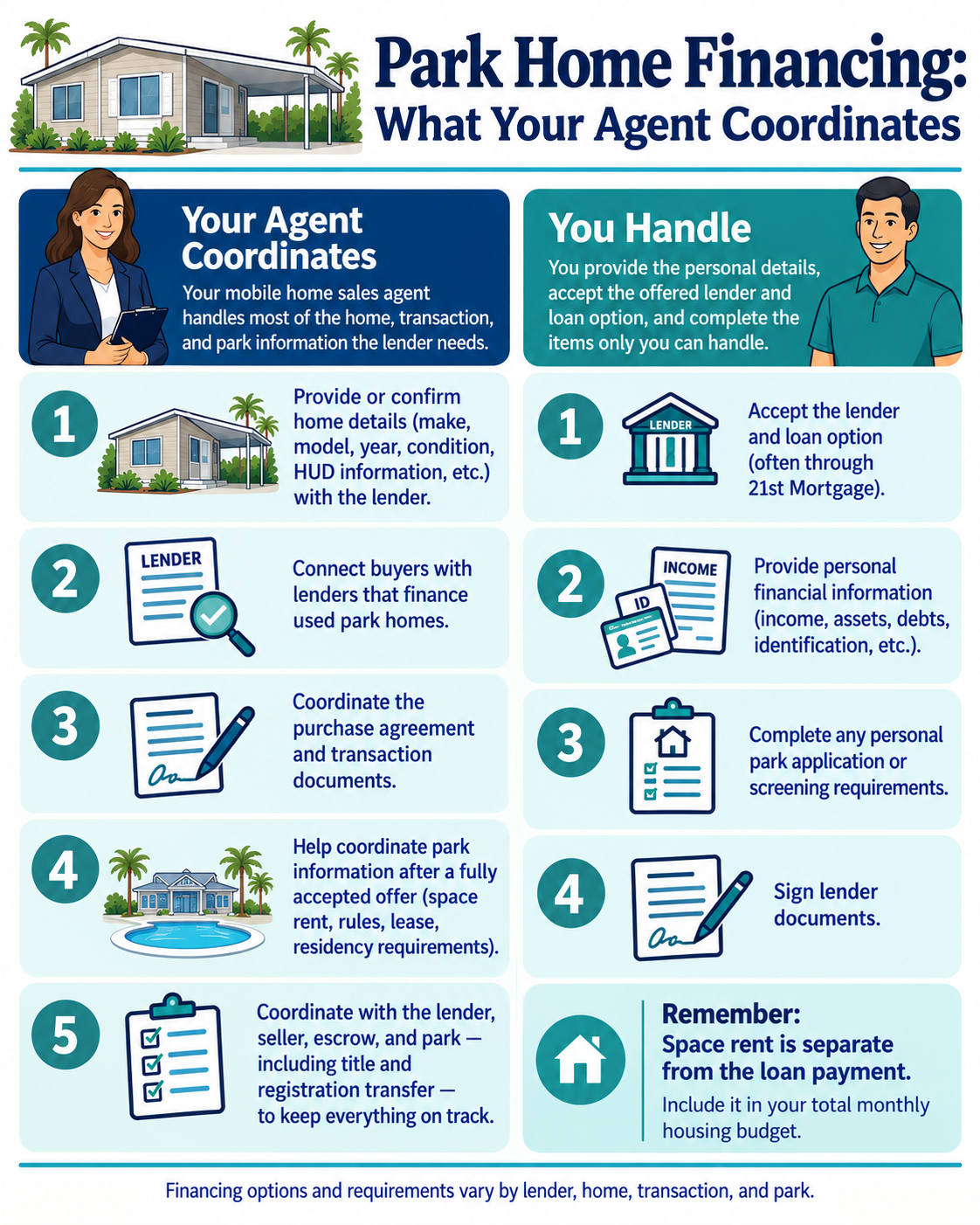
    Park home financing workflow showing what a mobile home sales agent coordinates and what the buyer handles, including home details, lenders, transaction documents, park information, personal financial information, park applications, and lender signatures.
    A mobile home sales agent helps coordinate the home, lender, transaction, and park information. The buyer handles personal financial information, accepts the offered loan option, completes park application requirements, and signs lender documents.

    A chattel loan may finance a mobile home on a rented lot without using the land as collateral. This type of financing generally applies when the manufactured home is titled separately from the land.

    Loan options and terms depend on the lender, home, park, and transaction. Traditional real-property mortgages may not fit a home-only purchase because those loans commonly involve the home and land together.

    Some government-backed financing programs may be available when their requirements are met. A mobile home sales agent can help connect buyers with lenders that finance used park homes and coordinate the home-related information those lenders request.

    The buyer reviews the lender and loan option offered for the home, including the financing terms and required personal documentation.

    What Down Payment and Loan Terms Can You Expect?

    Down payment requirements, interest rates, repayment terms, and fees depend on the lender, home, park, and financing program.

    The lender will request the personal financial information needed to evaluate the buyer’s application. This may include income, assets, debts, identification, and available funds. The mobile home sales agent can coordinate the home and transaction information separately.

    Chattel loans can have different repayment periods and interest rates, so buyers should understand the full terms of the offered financing arrangement before accepting it.

    Review the down payment, monthly loan payment, interest rate, repayment term, fees, and any prepayment provisions.

    Space rent is separate from the home’s loan payment and should be included when evaluating the total monthly housing cost.

    To compare the home payment with space rent and other expected housing expenses, use the SD Mobile Home Guide affordability calculator as an educational budgeting tool. It does not determine lending decisions or loan terms.

    How Do Age and Condition Affect Financing?

    A mobile or manufactured home’s age and condition can affect the financing options available. Requirements vary by lender, financing program, home, and transaction. A lender may request an inspection, appraisal, or other documentation concerning the home.

    The mobile home sales agent can help provide or confirm the home’s make, model, year, serial number, condition, and available identifying information. HUD certification or data-plate information may also be requested when applicable.

    Some financing programs have requirements related to the home’s age, construction standards, condition, or valuation. The lender determines whether the specific home meets its requirements.

    Problems with the roof, plumbing, electrical system, structure, or other components may lead to additional documentation or repair requests. An appraisal or valuation may also affect the financing amount a lender is willing to offer.

    When the lender identifies a concern involving the home, the mobile home sales agent can help coordinate the requested information with the seller and other transaction participants.

    How Do Park Rules and Space Rent Affect Financing?

    Park residency and home financing are separate parts of the transaction. However, a lender may need information about the park’s rental or lease arrangement before completing the financing process.

    After a fully accepted offer, the mobile home sales agent can help coordinate the current space rent, written rules, rental or lease information, and residency requirements for the specific home and space with park management.

    The buyer completes the personal portions of the park’s residency application and screening process directly with management. In the agent-assisted workflow described here, this is generally handled before the buyer signs the final lender documents, although the timing of particular lender forms can vary.

    Space rent also affects the buyer’s monthly housing budget. The agent can help explain the current space rent separately from the loan payment so the buyer understands both expenses.

    Requirements vary by park, home, transaction, and lender. The agent helps coordinate the home and park information while the lender handles its financing review and park management handles the residency process.

    How Does Your Agent Coordinate Park Home Financing?

    In a transaction handled by a mobile home sales agent, the agent coordinates much of the home, transaction, and park information needed for financing. The buyer handles the personal information and required actions that only the buyer can complete.

    The agent generally begins by providing or confirming the home’s identifying information, including its make, model, year, serial number, condition, and available HUD information when applicable. The agent can then help connect the buyer with lenders that finance used park homes.

    The agent coordinates the purchase agreement and other transaction documents needed for the financing process.

    After a fully accepted offer, the agent can help coordinate access to the current space rent, written rules, rental or lease information, and residency requirements directly from park management.

    Throughout the transaction, the agent works with the lender, seller, escrow, and park management to help keep the necessary documents and information coordinated. This includes confirming that the seller’s title and registration are ready for transfer and helping coordinate those documents through escrow or the applicable transfer process. The buyer is not expected to take possession of the original title and registration during this process.

    The buyer’s responsibilities generally include reviewing and accepting the offered lender and loan option, supplying requested personal financial information, completing the personal park residency application or screening requirements, and signing the required lender documents.

    Although specific lender and transaction procedures can vary, this agent-assisted approach helps keep the home and transaction coordination separate from the buyer’s personal responsibilities.

    Conclusion

    You may be able to finance an existing mobile or manufactured home in a San Diego park even when the land is not included in the purchase. Available financing depends on the home, lender, transaction, and financing program.

    When working with a mobile home sales agent, the agent can help coordinate home details, lender connections, purchase and transaction documents, park information after a fully accepted offer, and communication with the seller, lender, escrow, and park. Title and registration are handled as part of the transaction and transfer process.

    The buyer generally reviews and accepts the offered financing arrangement, provides personal financial information, completes the personal park residency application or screening requirements, and signs lender documents.

    Remember that space rent is separate from the loan payment and should be included in the total monthly housing budget. SD Mobile Home Guide is not a lender or underwriter. To explore homes for sale, visit SD Mobile Home Guide.
  • What Buyers Should Know About Property Taxes on Manufactured Homes in California

    What Buyers Should Know About Property Taxes on Manufactured Homes in California

    What Buyers Should Know About Property Taxes on Manufactured Homes in California

    In California, a manufactured home may be subject to annual local property tax or an annual vehicle license fee, also called an in-lieu fee. The tax system depends mainly on when the home was first sold new and whether it was later converted to local property taxation. A home can still have an HCD title and registration while being subject to local property tax, so HCD registration by itself does not tell you which tax system applies.

    Before buying, start with the current title and registration, then confirm the home’s tax status with the California Department of Housing and Community Development (HCD) or the county assessor as appropriate. If the home is in a mobile-home park, space rent is separate from the home’s property tax or in-lieu fee.

    Will Your California Manufactured Home Pay Property Tax or an In-Lieu Fee?

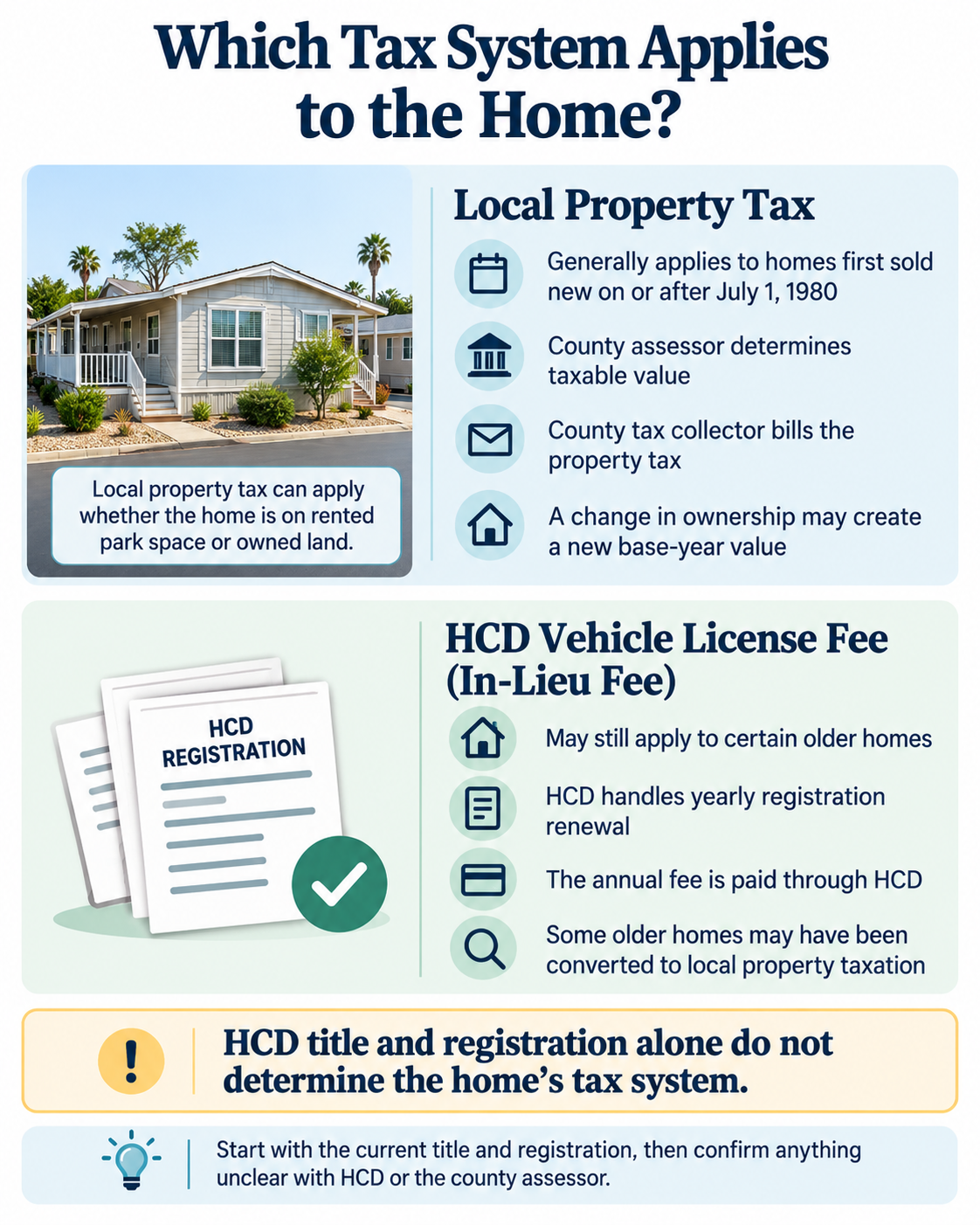
    Comparison of local property taxation and the HCD in-lieu fee system for California manufactured homes.
    Confirm whether the specific home is on local property taxation or the HCD in-lieu fee system before estimating ongoing ownership costs.

    A manufactured home first sold new on or after July 1, 1980 is generally subject to local property taxation. A home first sold new before that date may still be under the annual HCD vehicle license fee, or in-lieu fee, system if it was not later converted to local property taxation.

    Owners of certain older homes can voluntarily convert from the in-lieu fee system to local property taxation. Once a home is converted to local property taxation, it cannot be converted back to the in-lieu fee system.

    Do not assume that an HCD title or registration card means the home is on the in-lieu fee system. HCD has transfer procedures for both locally taxed homes and homes on yearly registration renewal.

    Use the current title and registration as your starting point, and confirm the tax status with HCD or the county assessor if it is unclear.

    How Does Owning the Land Affect Your Tax Bill?

    If you own the land beneath an HCD-titled manufactured home that is subject to local property taxation, the county generally assesses the land separately from the home.

    A manufactured home that has been installed on an approved permanent foundation and completed the process to become real property is treated differently. In that situation, the home is taxed as real property with the land rather than under the manufactured-home property-tax rules that apply to an HCD-titled home.

    Your property-tax bill can also include taxable improvements and voter-approved assessments or other charges that apply to the property.

    Review the home’s title and registration and the county property records so you understand how the home and land are currently treated.

    What Do California Mobilehome Park Residents Pay?

    If you buy an existing mobile home in a California park and rent the space beneath it, the space rent is separate from the home’s tax obligation.

    The home itself may be subject to local property tax or, for certain older homes, the HCD in-lieu fee system. A locally taxed manufactured home can remain personal property even though the county assesses it under the Manufactured Home Property Tax Law.

    For a locally taxed manufactured home on rented or leased land, the county assessor does not include value attributable to the particular rented site when valuing the home.

    After you have a fully accepted offer on a specific park home, get the current space rent, utility-billing information, and other recurring park charges directly from park management so you can budget those costs separately from taxes.

    How Does California Assess a Manufactured Home’s Taxable Value?

    For a manufactured home subject to local property taxation, a change in ownership generally establishes a new base-year value based on the home’s full cash value at that time.

    In later years, the assessor generally enrolls the lower of the adjusted base-year value or the home’s current full cash value. The inflation adjustment to the base-year value is limited to no more than 2% per year under California’s Proposition 13 rules.

    If the home’s market value falls below its adjusted base-year value, contact the county assessor about a possible temporary reduction in assessed value.

    The home’s age, condition, features, and market evidence can affect its assessed value. For a home on rented or leased land, the assessor does not include site value attributable to the rented space.

    Who Collects California Manufactured Home Taxes?

    For a manufactured home subject to local property taxation, the county assessor determines the taxable value and the county tax collector bills and collects the property tax.

    For a home that remains under the HCD vehicle license fee, or in-lieu fee, system, HCD handles the yearly registration renewal and applicable in-lieu fee.

    Because both locally taxed homes and yearly-renewal homes can have HCD title records, check the home’s current documents and contact HCD or the county assessor if the tax status is not clear.

    When Are Manufactured Home Taxes Due in California?

    For a manufactured home subject to local property taxation, the annual tax is generally payable in two installments. The first installment is due November 1 and becomes delinquent after December 10. The second is due February 1 and becomes delinquent after April 10.

    A purchase or other change in ownership of a locally taxed manufactured home can also result in a supplemental assessment. Supplemental bills have their own due and delinquency dates based on when the bill is issued.

    If the home is under the HCD in-lieu fee system, follow the renewal and payment information provided by HCD.

    Check the actual county tax bill or HCD renewal notice for the dates and payment instructions that apply to the home.

    How Can You Estimate Taxes Before Buying a Manufactured Home?

    Before buying, review the current title and registration and determine whether the home is on local property taxation or the HCD in-lieu fee system. If the status is unclear, confirm it with HCD or the county assessor.

    If local property tax applies, ask the county assessor how the home is currently assessed and how a change in ownership may affect the assessed value. The final tax bill can also include voter-approved assessments or other charges that vary by location.

    If the home remains under the HCD in-lieu fee system, review the current renewal information and ask HCD about the fee that applies to the home.

    For a locally taxed manufactured home, also allow for the possibility of a supplemental assessment after the purchase. If you are comparing the home price, taxes, space rent, and other monthly housing costs, use the SD Mobile Home Guide affordability calculator as an educational budgeting tool rather than a tax estimate or financing-approval tool.

    Conclusion

    Before buying a manufactured home in California, determine whether the home is subject to local property tax or the HCD in-lieu fee system. Start with the current title and registration, then confirm anything unclear with HCD or the county assessor.

    If the home is in a mobile-home park, keep the home’s tax obligation separate from space rent, utilities, and other park charges. If you are buying a home with land, also review how the land and home are classified and assessed. Understanding the home’s current tax status before closing will give you a more accurate picture of your ongoing ownership costs.

  • How Manufactured Home Financing Differs From Traditional Home Financing in California

    How Manufactured Home Financing Differs From Traditional Home Financing in California

    How Manufactured Home Financing Differs From Traditional Home Financing in California

    In California, manufactured-home financing can differ from mortgage financing for a site-built house because the home may be financed separately from the land or as part of real property with owned land. For an existing home in a mobile-home park, the buyer is typically financing a home that is already located in the community while separately budgeting for space rent and other recurring park costs. For a manufactured home sold with owned land, mortgage financing may be available when the property meets the lender’s and loan program’s requirements.

    The available options depend on the home, land ownership or site arrangement, title and property status, age and condition, applicable HUD construction standards, the loan program, the lender, and the borrower’s finances. Some government-backed programs also allow financing for manufactured homes on leased lots. SD Mobile Home Guide is not a lender or underwriter. Before comparing loan payments, you can use the SD Mobile Home Guide affordability calculator as an educational budgeting tool to estimate how the home payment, space rent when applicable, and other housing costs may fit your budget.

    How Are Manufactured Home Loans Different?

    A traditional real-estate mortgage is secured by real property. Manufactured-home financing can work differently because some transactions finance the home itself without the land, while others finance the home and owned land together.

    A loan secured primarily by the manufactured home rather than the land is often described as personal-property or chattel financing. A mortgage product for a manufactured home generally has separate property, foundation, title, appraisal, and program requirements.

    Requirements are not the same across every lender or loan program. Ask potential lenders whether they finance the specific type of manufactured home and land arrangement you are considering and which property requirements apply.

    How Does Land Ownership Shape Your Loan Options?

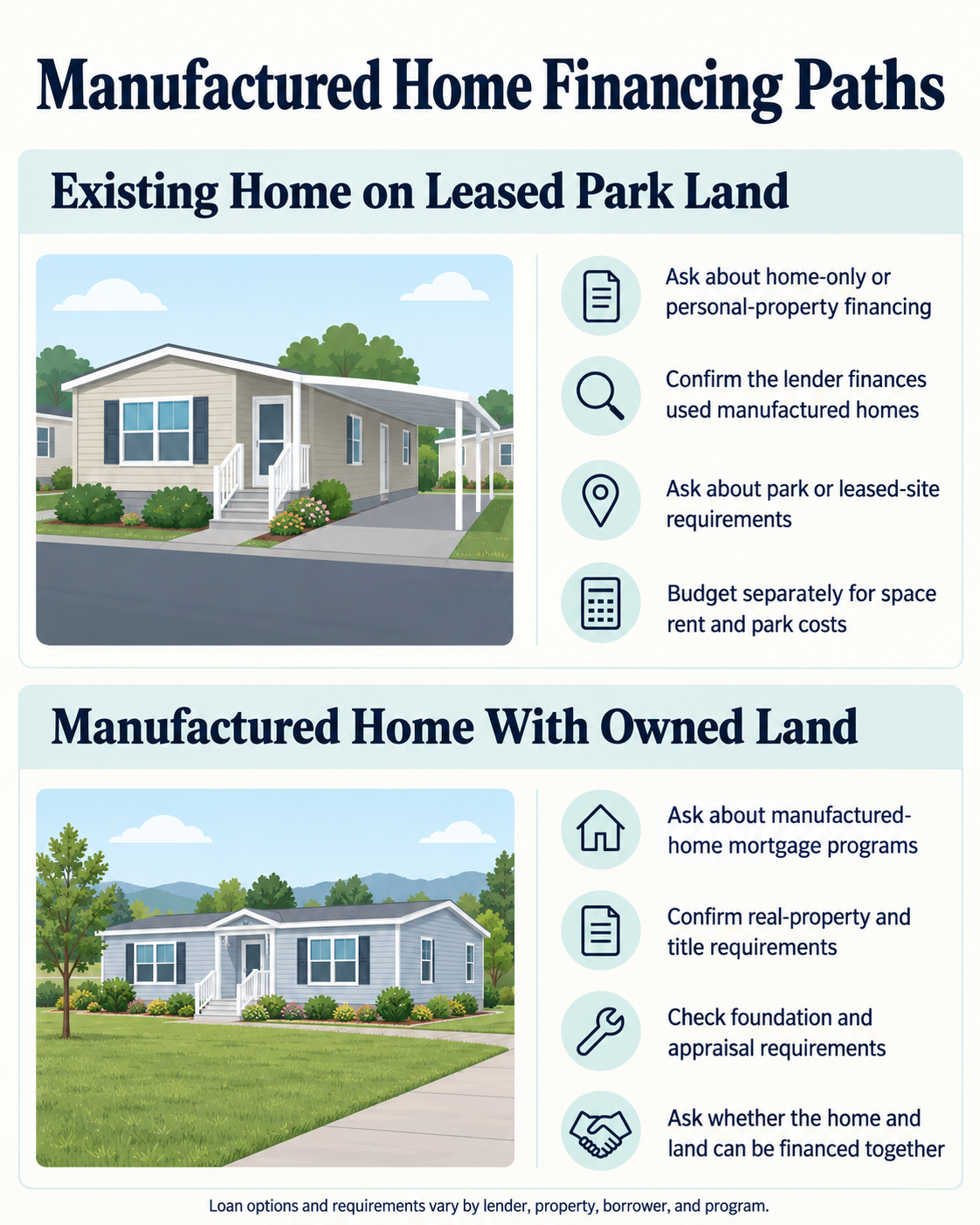
    Comparison of financing questions for a manufactured home on leased park land versus a home with owned land.
    Match the financing questions to whether the manufactured home is on leased park land or sold with owned land.

    Land ownership is one of the main differences between manufactured-home financing and financing for a conventional site-built home.

    If you are buying an existing home in a San Diego mobile-home park, the home is already located on a rented space. Ask lenders whether they finance used manufactured homes on leased land and what park, lease, or site requirements they have. Separately, after you have a fully accepted offer, get the current space rent, written park rules, utility information, and residency-approval requirements directly from park management.

    If you are buying a manufactured home with owned land, ask lenders about mortgage programs that finance the home and land together and what real-property, foundation, appraisal, and title requirements apply.

    Land ownership is not the only path to manufactured-home financing. For example, FHA’s Title I Manufactured Home Loan Program can finance a manufactured-home unit on a leased lot when the program’s requirements are met. The availability of any particular program still depends on the lender, property, borrower, and current program rules.

    When Can Mortgage Financing Be an Option?

    Mortgage financing can be an option when the manufactured home and property meet the requirements of the specific mortgage program and lender.

    For example, Fannie Mae’s manufactured-housing guidelines require the home to be attached to a permanent foundation system and the home and land to be legally classified as real property. Other mortgage and government-backed programs have their own requirements.

    Manufactured homes built under the federal HUD Code carry certification labels and have a data plate with identifying and construction information. The HUD Code took effect for manufactured homes produced on or after June 15, 1976. A lender or loan program may require evidence that the home meets applicable manufactured-housing standards, but the exact documentation varies by program.

    Ask the lender to identify the property, foundation, appraisal, occupancy, title, and borrower requirements for the specific program before relying on that financing option.

    What If the Manufactured Home Is Personal Property?

    If the manufactured home remains titled as personal property, financing may involve a home-only or personal-property loan rather than a real-estate mortgage. This is a common financing category to ask about when the home is in a mobile-home park and the buyer rents the space.

    The home serves as collateral for this type of financing rather than the underlying land. Interest rates, terms, down-payment requirements, fees, and underwriting standards vary by lender and product, so compare the actual loan disclosures rather than assuming the terms will match a mortgage.

    For a California HCD-titled home, confirm that the seller or mobile home sales agent has the current title and registration ready for transfer. The originals should remain secure and move through the transaction or escrow process as appropriate rather than being casually handed to the buyer.

    Which Financing Options Should You Ask About?

    The most useful starting point is to match the financing question to the property you are actually buying.

    For an existing home in a mobile-home park, ask lenders specifically about financing for a used manufactured home on leased land and what they require for the home, park, and site arrangement.

    For a manufactured home sold with owned land, ask about mortgage products for manufactured housing and the program’s real-property, foundation, appraisal, and title requirements.

    If you are buying a manufactured home and private land together, ask whether the lender can finance both in one transaction and what site or installation documentation applies. Those installation and site-work questions generally relate to a private-land placement project, not the normal purchase of an existing home already located in a San Diego mobile-home park.

    SD Mobile Home Guide is not a lender or underwriter. A lender must determine what financing, if any, is available for the specific borrower and property.

    What Do Manufactured Home Loans Cost in California?

    The cost of manufactured-home financing depends on the loan type, interest rate, annual percentage rate, term, down payment, and applicable fees.

    Depending on the product and transaction, costs can include origination, appraisal, title, recording, insurance, or other charges. Not every fee applies to every loan.

    Compare the annual percentage rate, monthly payment, cash needed at closing, loan term, fees, and total repayment information shown by each lender. A lower monthly payment does not necessarily mean a lower total borrowing cost.

    If the home is in a park, include the current space rent, separately billed utilities, insurance, maintenance, and other recurring park or housing costs when deciding whether the overall purchase fits your budget.

    What Should You Prepare Before Applying for a Loan?

    Ask each lender which documents it requires before you apply, because the list can vary by loan product and transaction.

    A lender may request information about income, assets, debts, credit, and the purchase agreement. For the home, it may also request identifying information, age, title or registration information, appraisal or inspection information, insurance details, and evidence related to HUD construction standards when applicable.

    If you are buying an existing park home, confirm that the seller or mobile home sales agent has the title and registration ready for transfer. After a fully accepted offer, get the current space rent, rules, utility information, and residency-approval requirements from the park manager, and ask the lender which park or rental documents it needs.

    If you are buying a manufactured home for private land rather than an existing park home, the lender may also ask for land, foundation, installation, site, or utility documentation that applies to that project.

    Conclusion

    Manufactured-home financing in California depends on more than the buyer’s finances. The home’s title and property status, whether the land is owned or leased, the type and age of the home, and the lender or loan program can all affect which financing paths are available.

    For a San Diego park purchase, focus on lenders that finance existing manufactured homes on leased spaces, confirm the seller or mobile home sales agent has the title and registration ready for transfer, and include the current space rent and other recurring costs in your budget. For a home with owned land, ask about manufactured-home mortgage programs and their property requirements. Compare the actual terms and disclosures from lenders before choosing a financing option.

  • Costs to Budget for When Buying a Manufactured Home in San Diego

    Costs to Budget for When Buying a Manufactured Home in San Diego

    Costs to Budget for When Buying a Manufactured Home in San Diego

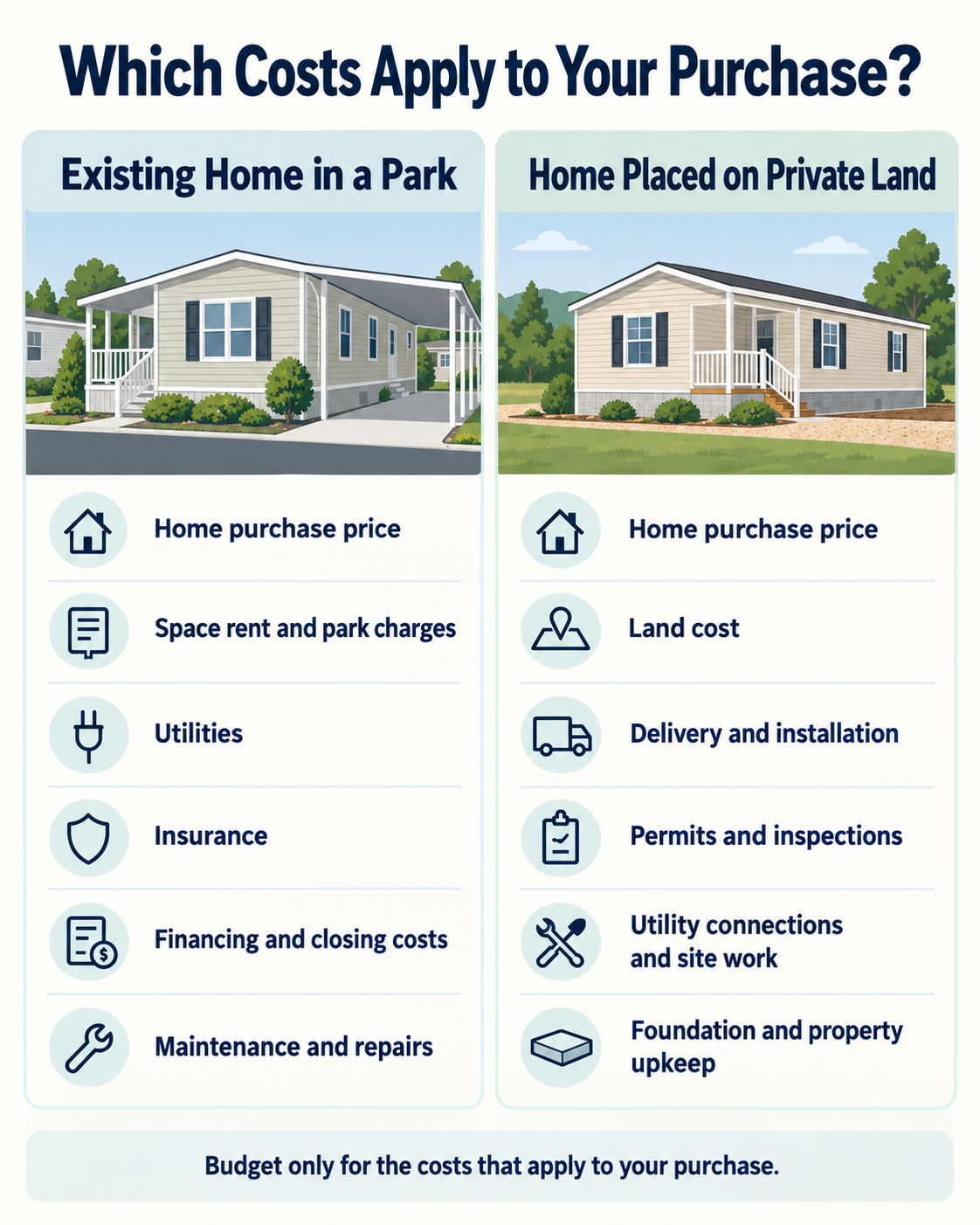
    When buying a manufactured home in San Diego, start by separating two different situations. If you are buying an existing home already located in a mobile or manufactured-home park, budget for the purchase price, space rent, utilities, insurance, repairs, financing and closing costs, and other recurring park charges. If you are buying a manufactured home to place on private land, additional costs may include delivery, installation, permits and inspections, utility hookups, grading, drainage, and a foundation system.

    If you buy land with the home or place a home on land you own, include applicable property taxes, insurance, and upkeep. If the home is already in a park, budget for space rent and the recurring costs that apply to that home and community. Set aside funds for utilities and repairs, and compare itemized quotes or estimates for the costs that actually apply to your purchase.

    What Does a Manufactured Home Cost in San Diego?

    The cost of a manufactured home in San Diego depends on its size, features, age, condition, and location. New and used homes can differ substantially in price, and upgraded finishes, energy-efficient systems, or custom layouts can affect the cost.

    If you are buying a new manufactured home to place on private land, ask for itemized dealer estimates.

    Check whether each quote includes delivery, setup, installation, and any options you select so you can compare the full purchase cost.

    Land Ownership or Space Rent: Which Fits Your Budget?

    Comparison of costs for an existing manufactured home in a park versus placing a manufactured home on private land.
    An existing home in a park and a manufactured home placed on private land can involve very different cost categories.

    When comparing manufactured-home costs, include the cost of the land or space. Buying land may require more money upfront, but you own the lot and do not pay monthly space rent for that land.

    You’ll also need to budget for applicable property taxes, insurance, and upkeep.

    If you buy an existing home in a manufactured-home park, the home is already located in the community and you’ll need to budget for monthly space rent and other recurring charges that may change over time.

    Compare land costs with the park costs that apply to the home you are considering. For a home in a park, confirm the current space rent and other park-specific charges directly with park management when that information is available; in many transactions, the buyer receives the specific park information after a fully accepted offer.

    The right choice depends on your budget and how much control you want over future housing costs.

    For an educational estimate of what may fit your monthly budget, use the SD Mobile Home Guide affordability calculator. It is a budgeting tool, not a financing approval.

    What Do Delivery, Installation, and Permits Cost?

    Delivery, installation, and permit costs are primarily relevant when a manufactured home will be transported and installed on private land. They are not part of the normal purchase of an existing home that is already located in a San Diego mobile-home park.

    If you are placing a home on private land, costs depend on the home, delivery route, site access, scope of work, and applicable requirements. Ask the retailer, installer, or other provider for an itemized estimate and confirm what the purchase price includes.

    Key expenses may include:

    1. Delivery: Distance, route conditions, and any required transport arrangements can affect the cost.
    2. Installation: Setting, leveling, securing, and connecting the home can vary with the site and installation requirements.
    3. Permits and inspections: Applicable permits, inspections, and fees depend on the work and the agency with jurisdiction.

    Get written quotes and confirm the requirements that apply to the site and work before signing contracts.

    For help comparing homes for sale, visit the SD Mobile Home Guide.

    How Much Do Utilities and Site Work Add?

    New utility connections and site work are mainly costs to consider when a manufactured home will be placed on private land. They are different from the monthly utility charges you may pay when buying an existing home in a park.

    For a private-land project in San Diego, expenses depend on the property’s condition, location, and access to existing services. Connecting water, sewer, electricity, or gas may cost more when lines are farther away or upgrades are needed. A property without public water or sewer may require another approved water or wastewater system.

    Site work may include grading, drainage improvements, soil testing, vegetation removal, and foundation construction, depending on the property and project.

    If site work or new utility connections are part of your private-land purchase, ask qualified contractors or service providers for itemized estimates. This can help you budget for conditions that are not obvious at first.

    What Are the Ongoing Costs of Owning a Manufactured Home?

    After you buy a manufactured home, budget for insurance, utilities, regular upkeep, and the taxes or HCD fees that apply to the home’s tax status. In California, a manufactured home may be subject to local property tax or an in-lieu license fee, depending on its tax status.

    If you buy an existing home in a park, account for space rent, other recurring park charges, and any utilities you pay separately, such as electricity, water, sewer, or trash.

    Set aside money for appliance care, roof maintenance, routine inspections, and unexpected repairs.

    Review your budget periodically and adjust it as your actual costs change.

    Conclusion

    Before buying a manufactured home in San Diego, budget for more than the purchase price and separate the costs that apply to your type of purchase. For an existing home in a mobile-home park, focus on space rent, utilities, insurance, financing and closing costs, maintenance, repairs, and other recurring park charges. For a manufactured home being placed on private land, delivery, installation, permits, site work, utility connections, and foundation costs may also apply.

    Get itemized estimates for the costs that apply to your purchase and confirm current park-specific charges with park management when appropriate. Use the SD Mobile Home Guide affordability calculator as an educational budgeting tool to compare what may fit your monthly budget over time.